The client
Mojo is a men's sexual wellness platform focused on psychological - rather than pharmaceutical - solutions to erectile dysfunction, performance anxiety and premature ejaculation.
Through the app and online content, Mojo aims to reduce stigma, improve access to psychosexual support, and offer a more sustainable alternative to quick-fix medication.
The challenge
Mojo's website was earning about 40,000 visits per month, but little of it turned into revenue.
Organic revenue was too low, and Mojo wanted a roadmap to improve conversions from their content, with the aim of hitting a lower blended CAC.
At the same time, and like most fast-growing startups, Mojo had limited resources to throw at a multitude of marketing channels — so they needed to understand the:
- total size of the SEO opportunity — in revenue terms
- investment necessary to take that opportunity
- potential return on investment
- likely timescales for that ROI
After some internal to-ing and fro-ing about the role of SEO within the marketing mix, Mojo realised they didn't have the right data to make a clear decision.
So they hired me to do what I like to think I do best: a big hefty strategic analysis, and a plan for growth.
The brief wasn't to execute, but to establish the strategic potential of SEO to inform decision-making and resource allocation.
The approach
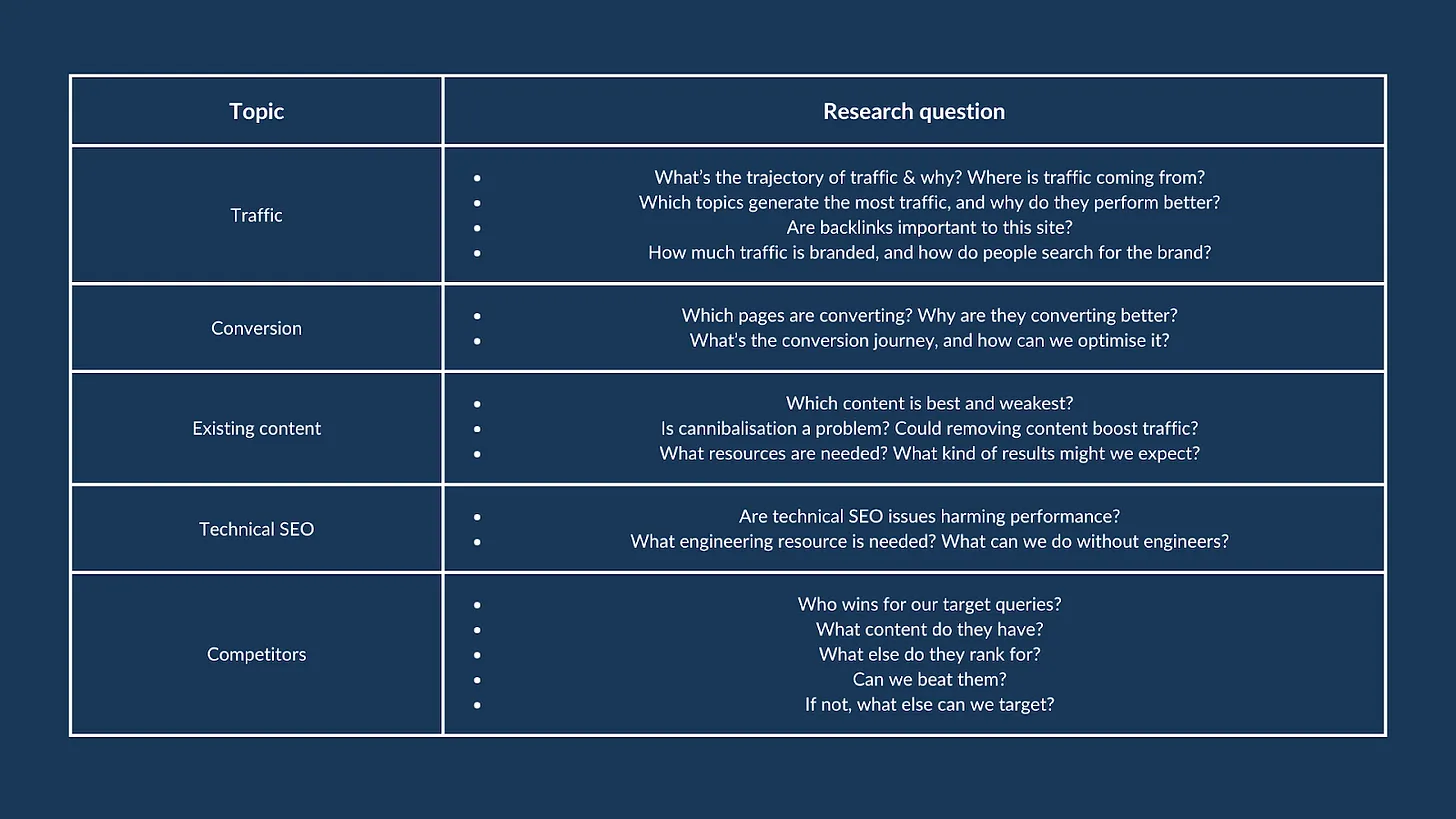
As always, I began by outlining a set of research questions, which define scope and keep the analysis laser-focused on the important stuff.
Those questions included:
- Which pages convert best? Why?
- What's the conversion journey, and how can we optimise it?
- What resources are needed to create the necessary content to hit Mojo's organic revenue targets?
- Which topics generate the most traffic, and why do they perform better?
- Are technical SEO issues holding back commercial performance? If so, what can we do with limited engineering resources?
Once I'd agreed the research questions with Mojo's team, it was time to dive into the detective work.
Step 1: analysing existing content to find patterns in conversion
The core of the brief was to establish whether and how organic marketing could generate a certain number of conversions each month. So I started by analysing URLs, title tags and existing queries to find associations between particular words, phrases and topics, and higher conversion rates.
Patterns emerged: although traffic was strong, it was concentrated on a handful of pages that didn't convert well.
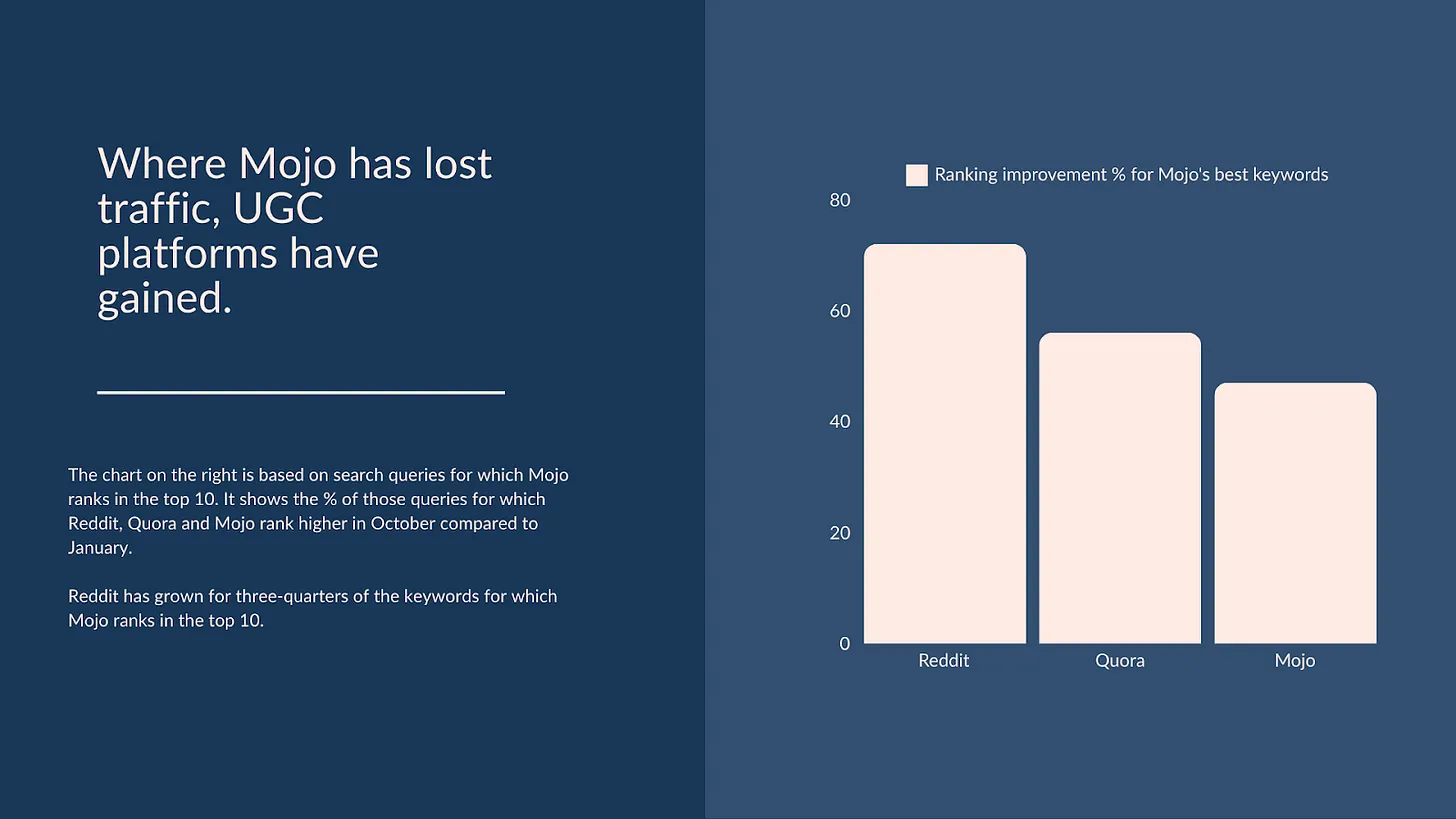
Typically, these high-traffic pages ranked for queries that were less “serious”.
Competition for these queries increasingly came from user-generated content sites like Quora and Reddit, rather than heavy-hitting medical sources.
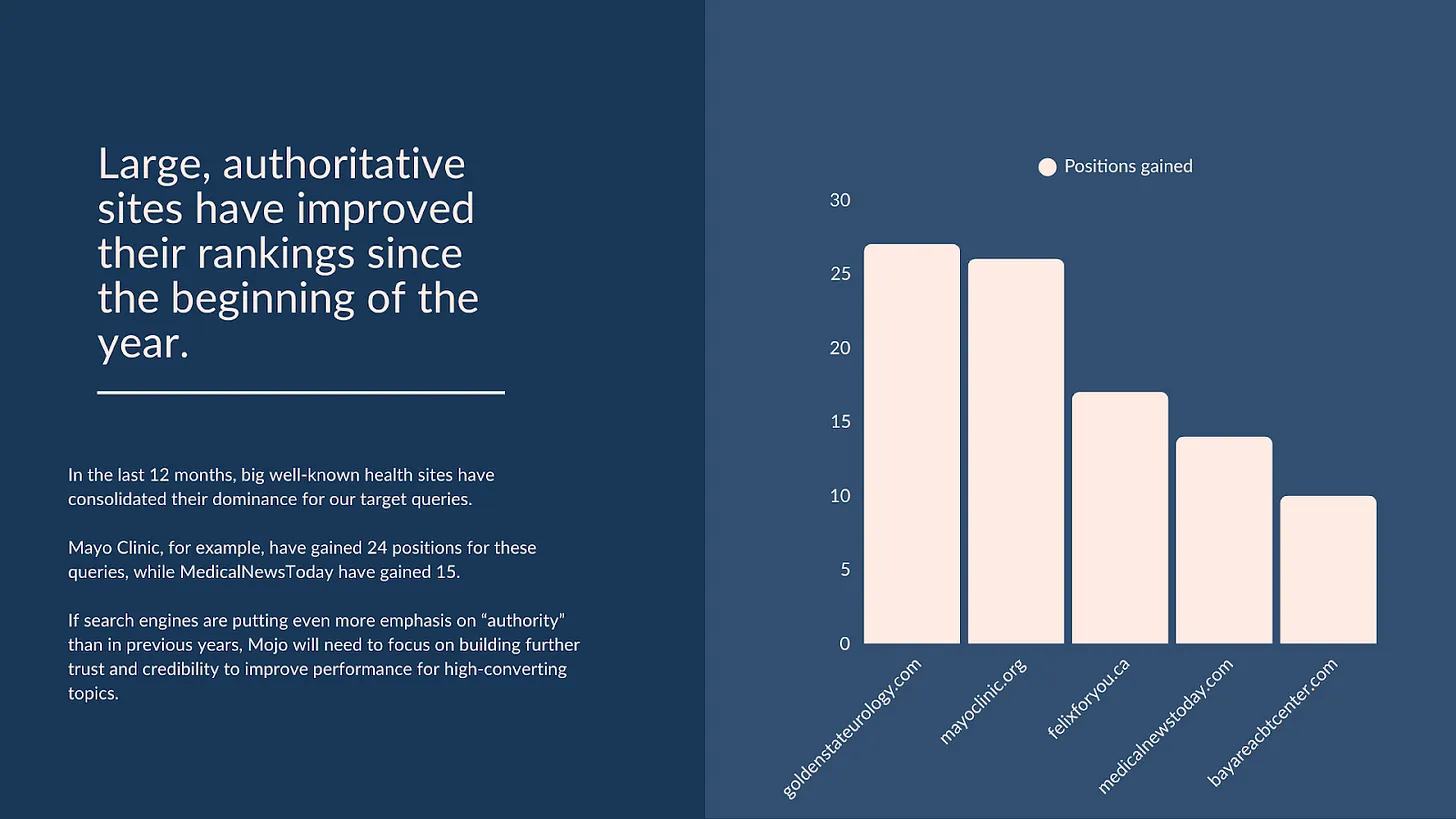
Meanwhile, a smaller group of more “serious” topics had far higher conversion rates, but Mojo had struggled to consistently rank well for them.
These topics were dominated by big, well-known medical sites like Mayo Clinic and MedicalNewsToday, and shifts in rankings following recent algorithm changes had made these sites' position even stronger.
Step 2: understanding what it would take to rank for high-converting topics
I'd established which kinds of queries would bring in the most revenue. But if ranking for those queries was prohibitively difficult, Mojo's marketing budgets might be better spent elsewhere.
So the second part of my analysis focused on understanding what it would take to win some of that high-converting traffic.
I looked at things like:
Backlinks
- Were backlinks important? What was the correlation between backlinks and rankings?
- Was it possible to rank well for lucrative queries with a weaker backlink profile than competitors?
- What kinds of backlinks did high-ranking sites get?
Brand mentions
- How much did people talk about the brand online? Where did they talk about it?
- Did the sentiment of brand mentions measurably affect rankings?
- Did brand combination searches affect rankings for unbranded queries in this context?
“Topical authority”
- Did Mojo consistently rank better for certain topics than for others?
- If so, why? And would this prevent them from ranking for higher-converting queries?
- Did Google consistently rank smaller sites with noticeable “topical authority” for these queries?
Content structure
- Did the format, clarity and structure of content affect rankings?
- Did readability scores correlate with higher rankings?
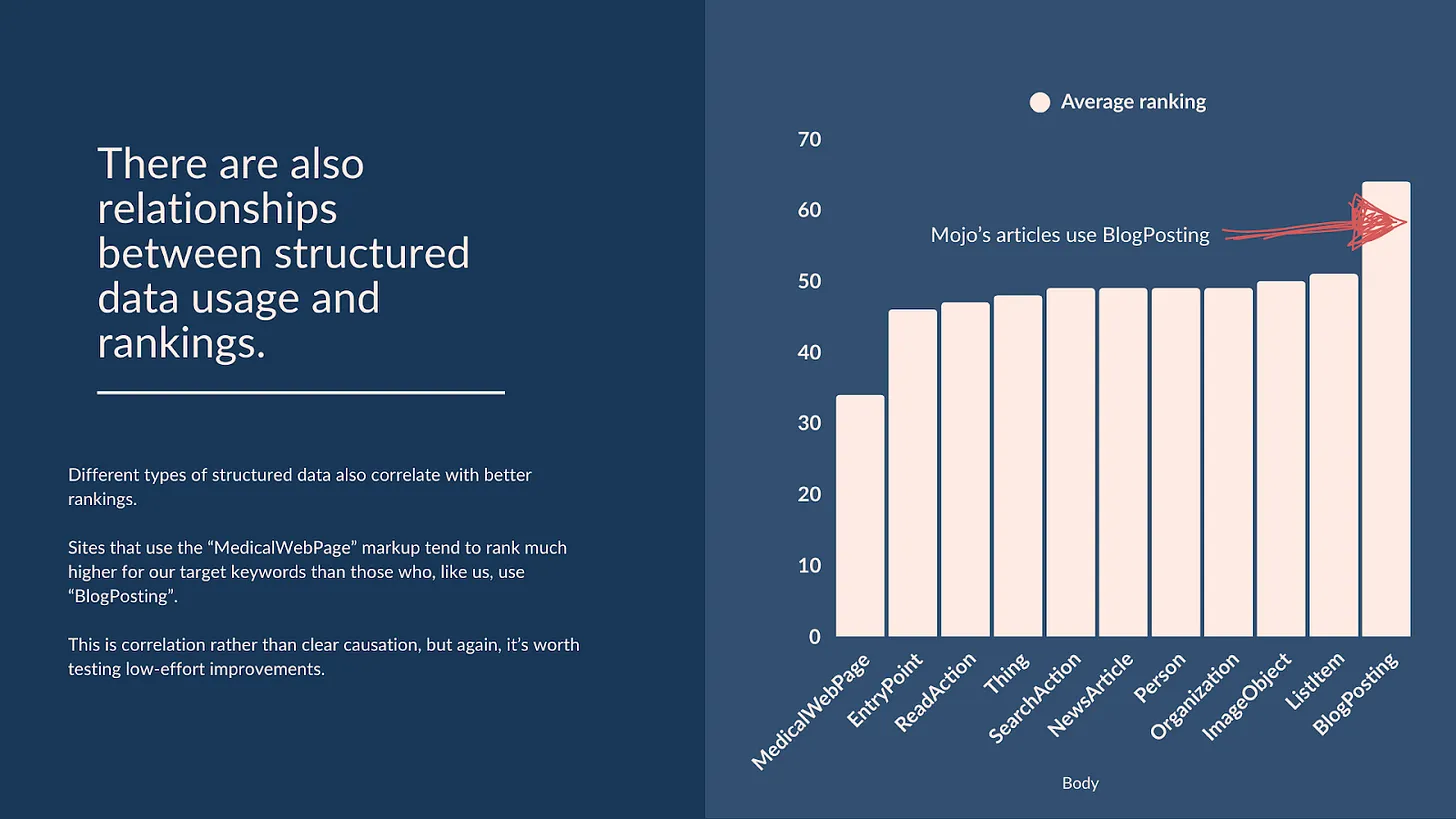
Structured data
- Did the use of structured data correlate with rankings?
- Which kinds of structured data, and what kind of information contained within it, were associated with higher rankings?
This part of the analysis gave us an idea of:
- whether it would be realistic to try and rank well for these queries
- what we'd need to do to improve rankings
- what kind of resources would be needed to do it (engineering vs. content, etc.)
Step 3: finding ready-made opportunities to create high-converting new content
Step 2 had focused on improving existing content. But having established which topics converted best, there was also a big opportunity in new content to target longer-tail, less competitive queries.
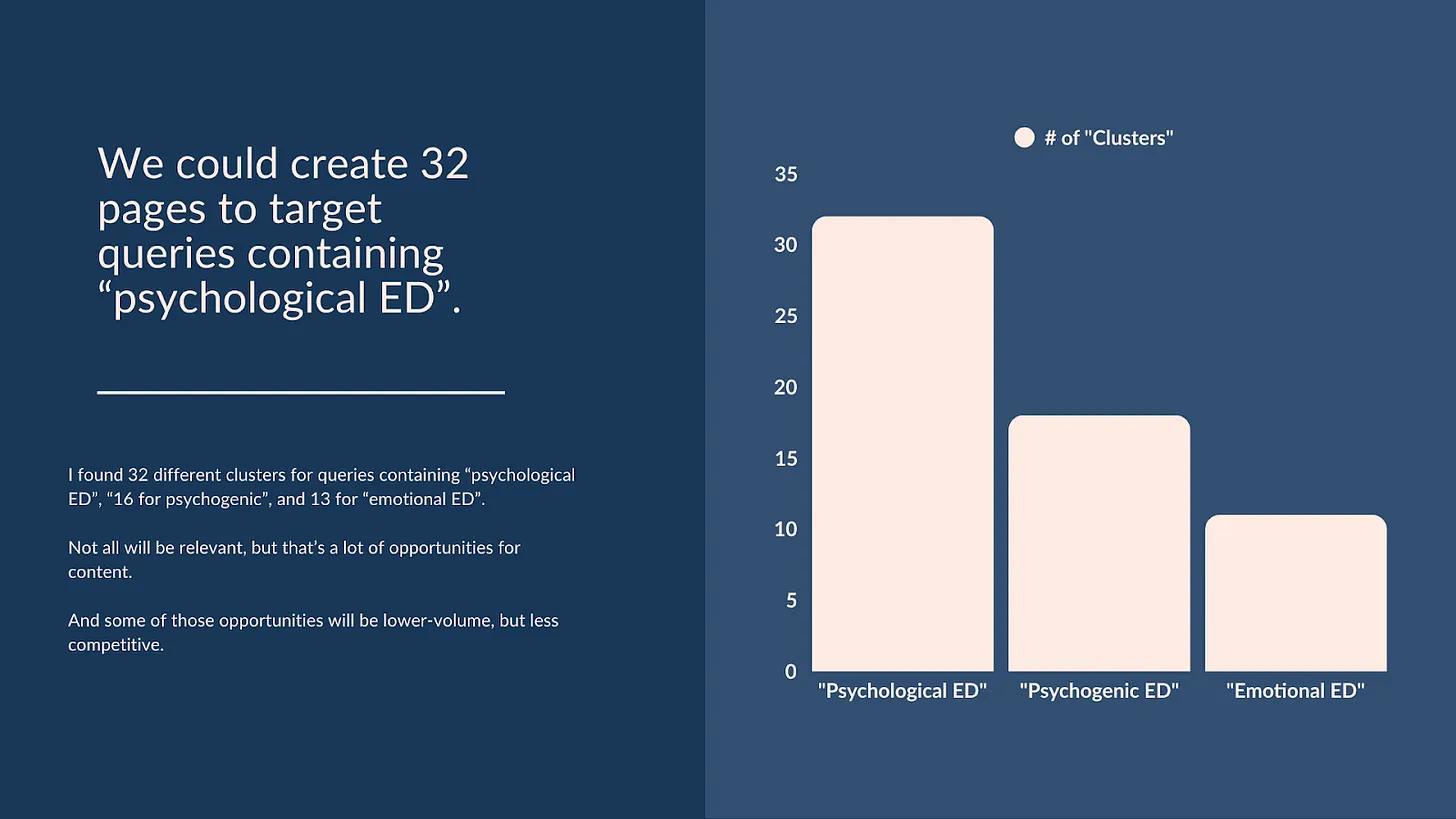
To find these opportunities, I turned to query clustering.
This involved:
- grabbing all the query data from Search Console for high-converting topics
- finding a bunch of additional queries in Ahrefs on similar topics that Mojo weren't yet ranking for
- grouping them by number of shared URLs in search results
The logic behind this clustering is that if Google is returning very different results for two queries, you need to target them with separate pages.
It's a great way to figure out how much content you need to create. It also picks out under-the-radar opportunities by aggregating search volume data for queries that, individually, look unpopular, but together have healthy search demand.
The goal here was to get a full list of new articles Mojo could write to target the full breadth of potential high-converting search demand, and to quantify the editorial resources they'd need to write it all.
Step 4: defining initiatives, scoping necessary resources and forecasting results
By now, we knew:
- what kind of content converted best
- why Mojo had historically struggled to rank well for high-converting queries
- what we'd would have to do to improve rankings
- where new content could target lower-competition queries
The final question left to answer was: by making the necessary investment to target this high-converting search demand, what kind of results could Mojo expect?
To answer this, I pulled together a nuanced forecasting model based on click-through rates and conversion rates for different topics.
Then, for each initiative I'd mapped out, I estimated three outcomes: conservative, balanced, and ambitious.
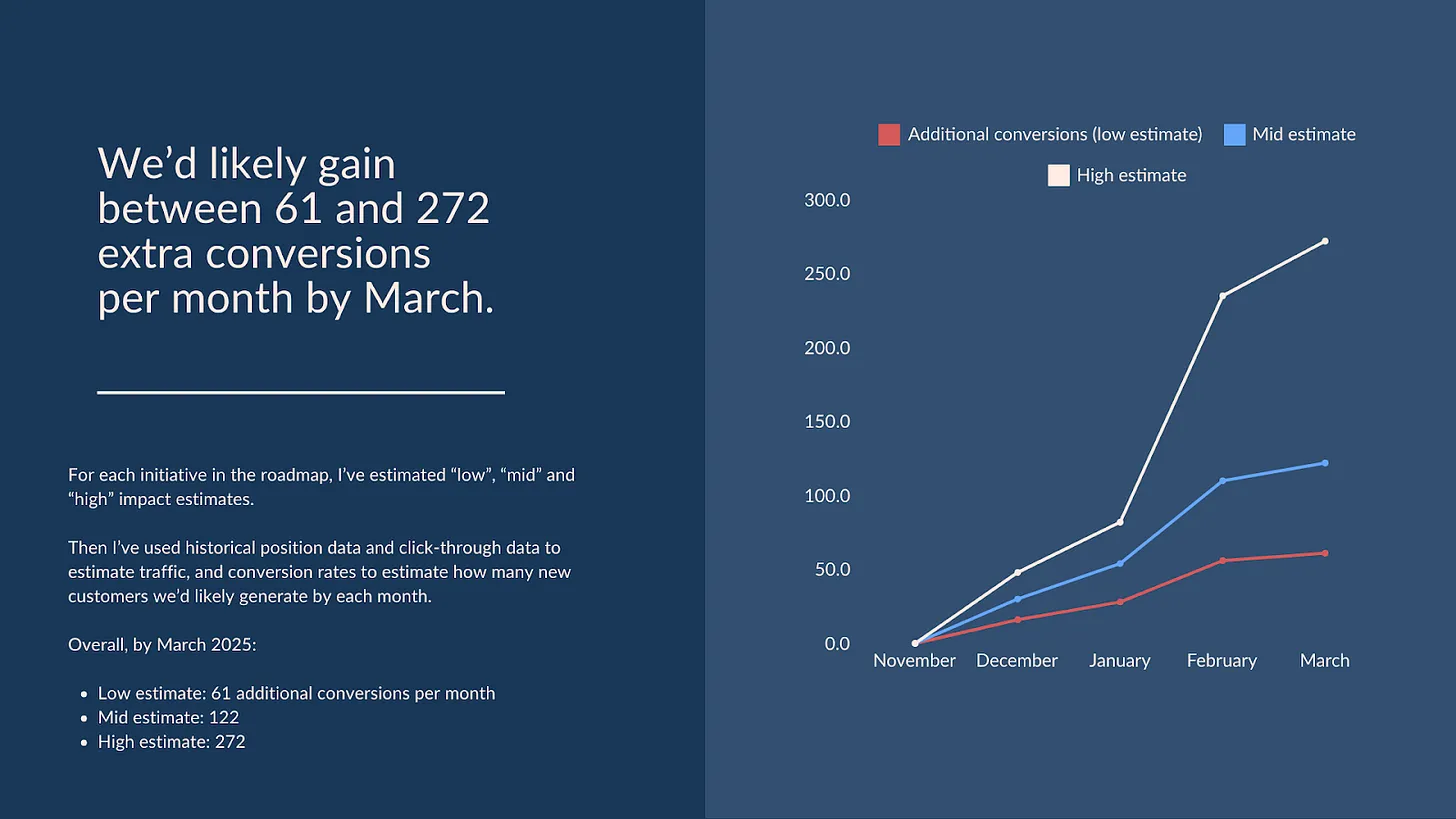
Using a forecasting model based on topic-level click-through rates, I could estimate how many additional conversions Mojo could expect by implementing the recommendations.
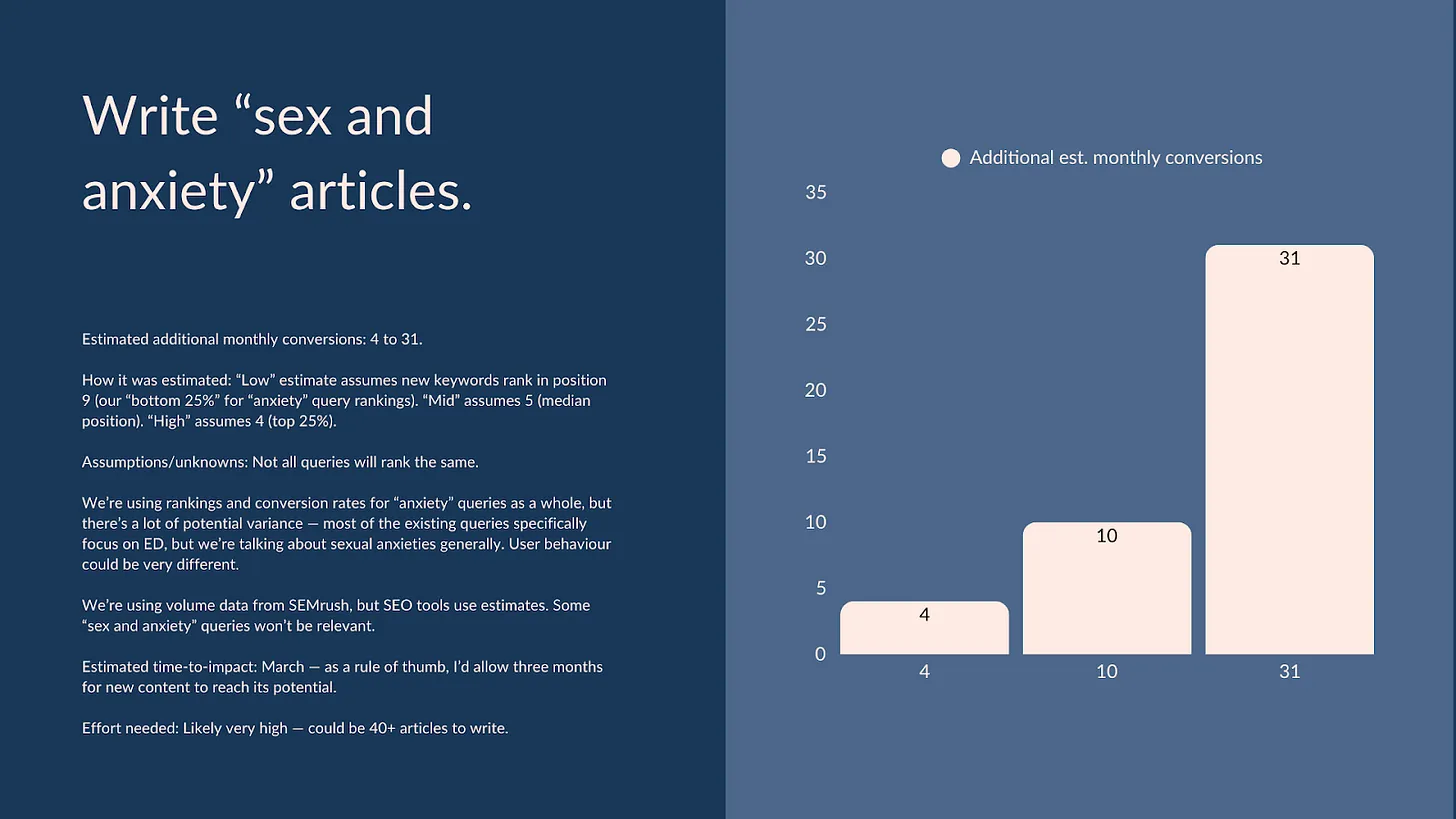
And because all SEO forecasting is based on loads of estimations (loath though the industry may be to admit it), which should be transparently caveated, for each initiative I detailed:
- how the estimations were made
- any assumptions or unknowns that might make the estimation less accurate
- how long it would likely take to see an impact
- how difficult it would be to implement
Finally, I put together a plug-and-play forecasting tool that allowed the team to model different levels of investment against projected outcomes.
This gave them a practical way to compare SEO's potential with other marketing channels and find the optimum level of investment, without relying on (too much) guesswork or inflated projections.
The results
This wasn't an execution brief — it was about clarity, prioritisation, and commercial thinking.
The analysis gave Mojo a clear sense of where their SEO performance stood, where the opportunities lay, and what it would take to pursue them.
It helped turn internal indecision into an informed, strategic conversation about whether and how to invest in organic growth.
In the words of co-founder Xander Gilbert (provided under minimal duress):
“Kurt's depth of analysis was really impressive. He pulled out insights to unlock growth that we would not have considered. He would be an asset to any SEO initiative.”
Xander Gilbert, Mojo co-founder
If you've got a similar project in mind, get in touch.