I was recently hired to analyse the impact of AI Overviews on a client's organic click-through rates. Most data on the topic is derived from broad analysis of multiple sites across multiple industries; my client wanted to know how it affected them specifically.
The results were interesting, so I rolled it out further, aggregating data from other clients' sites. Many of the patterns were consistent. Others weren't — but usually in interesting ways.
In short, I found:
- AI Overviews send next to no traffic to cited sources, as far as I can tell — even if the brand name is specifically mentioned in the text
- CTR drops a lot less when you rank in the first organic position, suggesting searchers often use the top organic result to validate what the AI Overview said
- Certain query formulations are less likely to trigger AI Overviews, typically those where text-based AI responses can't satisfy the query ("calculator", "template" etc)
- Lower-volume queries are less likely to trigger AI Overviews (consistent with other SERP features)
- The co-occurrence of certain other SERP features (especially Discussion+Forum features) offsets the drop in CTR from AI Overviews
Notes on the data
- SERP data comes from DataForSEO's API — that includes rankings, AI Overview counts, SERP feature presence, and AI Overview text and cited sources.
- SERP data is for the country from which each site gets the largest amount of traffic. User behaviour and AI Overview presence often varies between countries.
- Click and impression data comes from Search Console. It predates Google's deprecation of the &num=100 parameter, so impression numbers are likely inflated by bot searches.
- The sample size is relatively small — about 8,000 queries across 4 sites. It's directionally interesting rather than definitive.
- All four sites used for this analysis are mostly "content-driven" — that is, they get their organic growth from content marketing rather than product inventory. This means they're more likely to rank for "top-of-funnel" queries. I'd like to apply the same analysis to some marketplaces, ecommerce brands, aggregators and user-generated content (UGC) platforms: for these sites, which are more likely to rank for "bottom-of-funnel" queries, the impact of AI Overviews could be very different.
- Search volume numbers are taken from Keyword Planner.
- All data goes up to November 2025.
#1: AI Overviews are straightforwardly bad for traffic — nobody seems to click cited sources
Many brands are making AI Overview citations a specific goal. But across the four sites I analysed, it seems nobody clicks them.
This isn't straightforwardly measurable, because Search Console doesn't let you filter by AI Overviews. Instead, I looked at data for one client who are unusually dominant within a specific topic — for some AI Overviews, they're cited 4 different times with different pages.
The number of citations didn't make much difference to click-through rates — and any difference is likely explained by random variation. If users actually clicked citations — if being cited had measurable value in terms of traffic — you'd expect a greater number of citations to lead to a greater number and proportion of clicks.
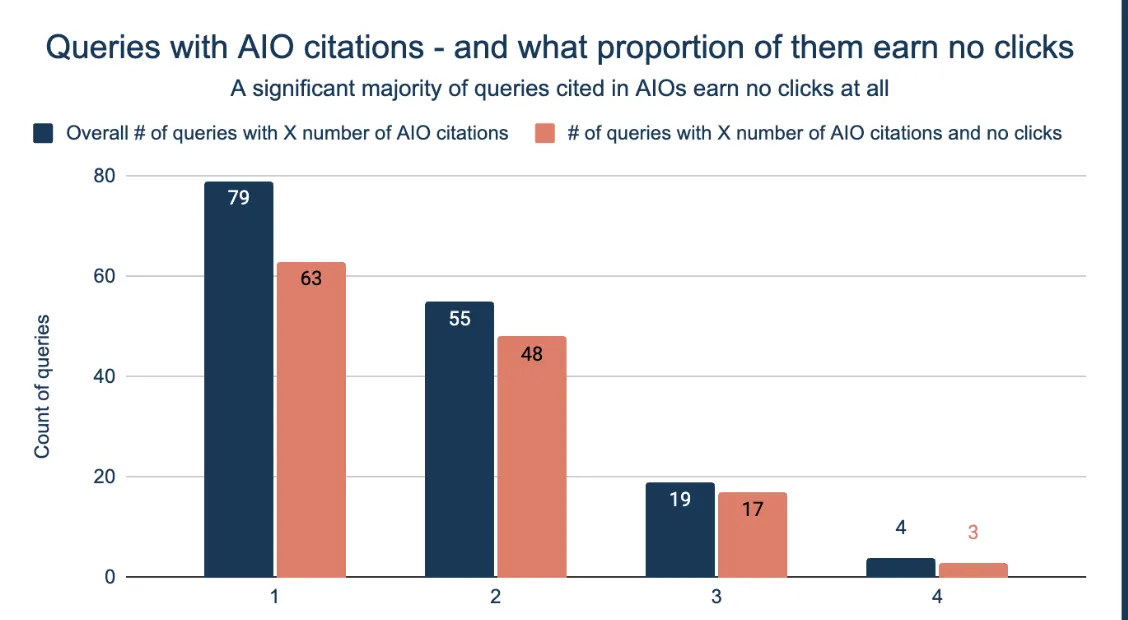
Whether being sourced in an AI Overview has more nebulous benefits to brand awareness, I can't say — but, across the four sites I analysed, it doesn't get you more traffic.
#2: AI Overviews that specifically mention the brand name don't perform meaningfully better than those that don't (at least in traffic terms)
But maybe people are more likely to click if the AI Overview specifically mentions you, rather than just citing you — "according to [brand]", etc.
Across this dataset — no, it doesn't. Around 90% of queries that mentioned the brand name sent no traffic to the site — higher than the 82% of queries triggering AI Overviews overall.
This one's a small sample size, though — less than 100 AI Overview brand mentions over the whole dataset. But there's no obvious difference made by getting a brand mention.
#3: AI Overviews reduce click-through rate less for sites in organic position 1 than for positions 2 and 3
This is the finding I found most interesting — CTR consistently dropped less when AI Overviews are present vs when they're not when the site ranks 1st in organic listings. For two of the four sites I looked at, CTR increased on average when AI Overviews were present and the client was in position 1.
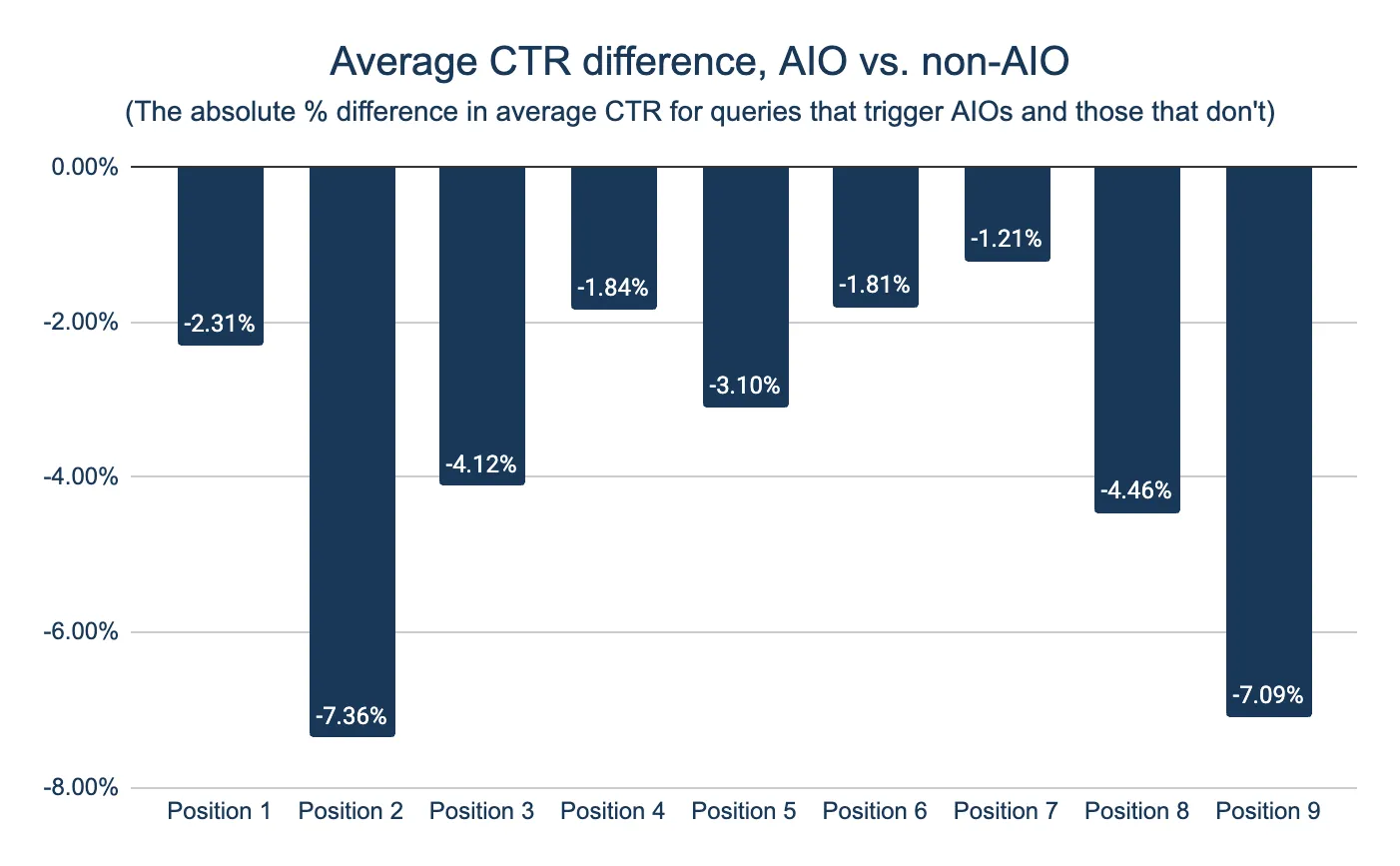
As ever, small sample sizes etc. We can't draw sweeping conclusions. But the fact it was consistent across all four sites is directionally interesting.
Perhaps it suggests that searchers get a summary of a topic from AI Overviews, and then validate what they read by clicking on the first search result. Which makes sense: generally, people don't trust LLMs. But where they might have once clicked the top 2 or 3 results to get a better sense of a topic, they might now use just the first one to validate what the AI summary told them.
This echoes the findings of Kevin Indig's remote usability study, which found that searchers tended to validate what they read in AI Overviews, but that research is potentially limited by the exaggeratedly thorough and conscientious behaviour exhibited by users in remote usability studies.
#4: Some queries are less likely to trigger AI Overviews than others, and have different CTRs when AI Overviews are triggered
Across all four sites, there were pockets of queries less likely to trigger AI Overviews. To measure this, I made an ngram model of the query list and aggregated AI Overview counts for each ngram.
The four sites are in different industries, so the patterns were particular to each site, but typically included formulations like:
- Calculator
- Checker
- Template
Other formulations were more likely to trigger AI Overviews, such as:
- "Formula"
- "Definition"
All of which is fairly intuitive: queries that are best satisfied by something other than a text-based explanation are less likely to trigger AI Overviews, and have a higher CTR when AI Overviews are triggered (in other words, when Google takes liberties with satisfying search intent).
If there's a lesson here, it's to focus on queries for which your website offers a better user experience than an AI Overview can.
#5: CTR decline varies significantly depending on the presence of other SERP features (but it's not necessarily causal)
The impact on CTR varied significantly when AI Overviews co-occurred with other SERP features. When the "Discussions and Forums" (D+F) feature also cropped up, CTR was much higher.
The causation is a bit mysterious here, but I suspect it has more to do with the kind of user behaviour that triggers D+F features than the impact on behaviour caused by D+F features.
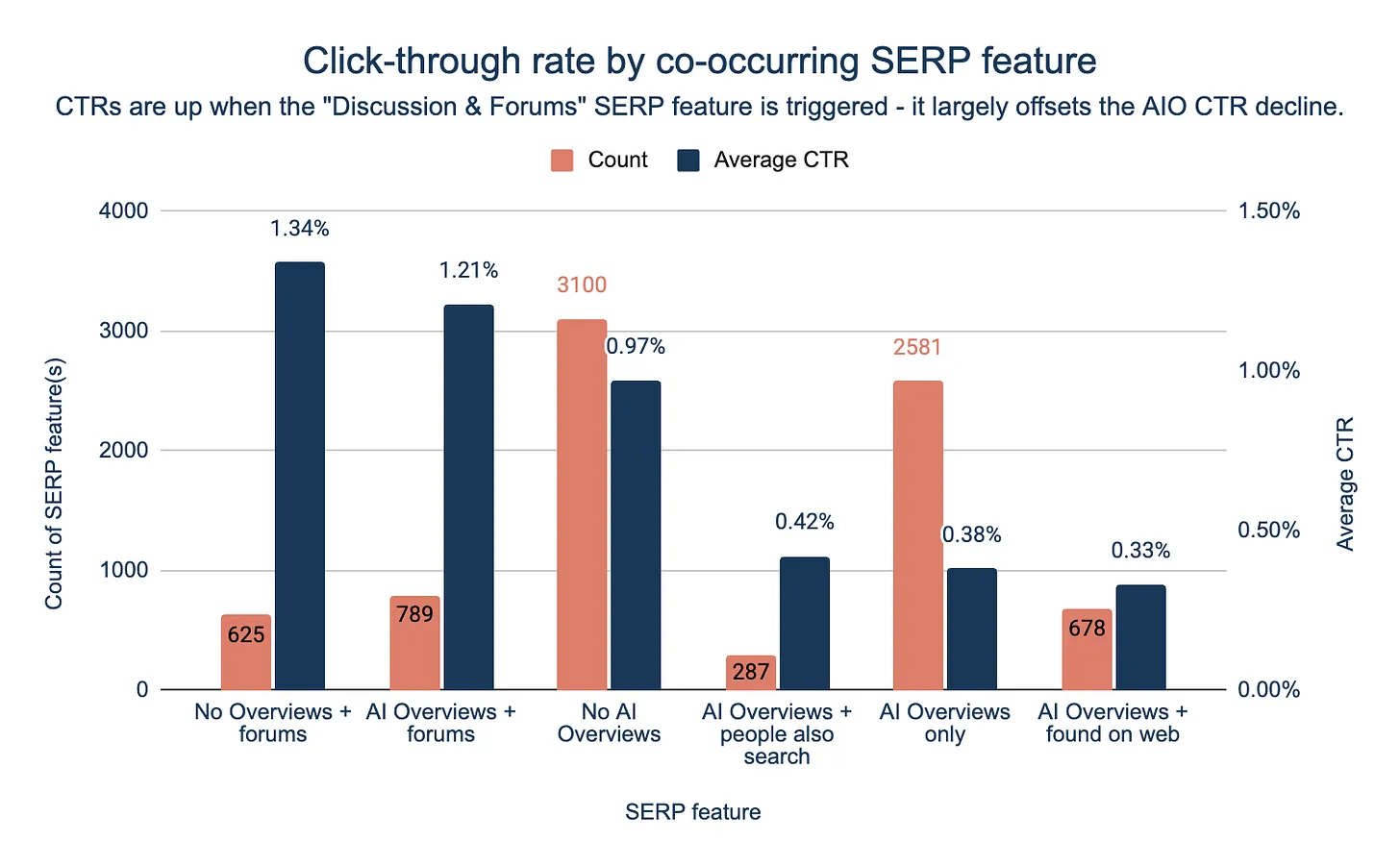
If there's a specific conclusion from this — other than "start a forum because they're all over the SERPs these days" — it's to pay attention to the specific things that are happening in the SERPs you're trying to get traffic from. It's not as simple as "AI Overview = low traffic, no AI Overview = high traffic".
#6: Higher-volume queries are more likely to trigger AI Overviews (as with other SERP features)
Higher-volume queries have always been more likely to trigger SERP features. Which makes sense: Google has more user interaction data, so is clearer on what features to trigger, and presumably has more incentive to keep searchers on-platform for popular queries.
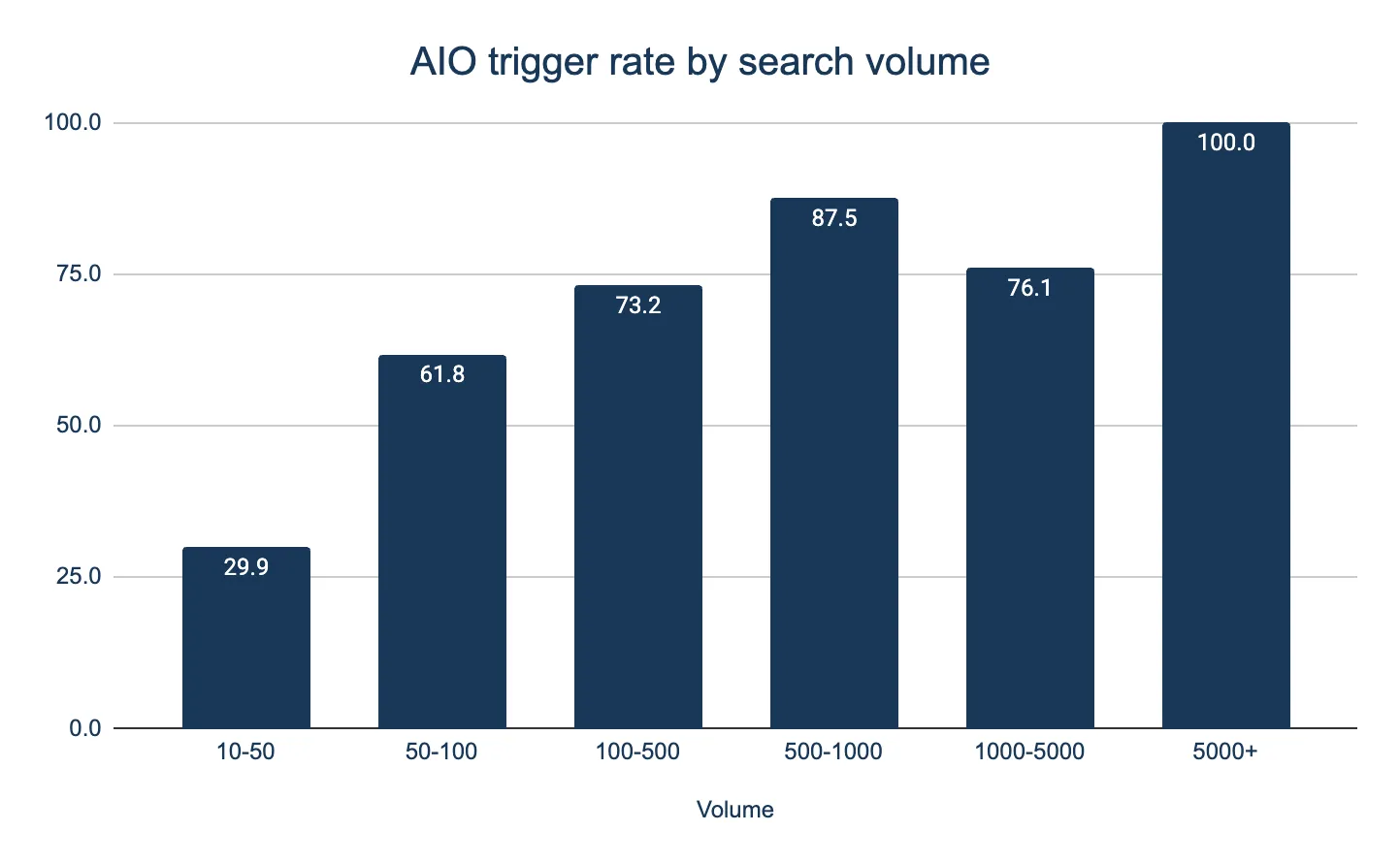
Given this, it makes sense to target relevance over volume. There may not be as many people searching for those queries, but you get a much higher proportion of them on your site.
Plus, it's also easier to rank 1st for niche, low-volume queries, which, across this dataset, tends to mean your CTR is less affected by AI Overviews.
What this could mean for your SEO strategy
Again, the sample sizes in this analysis are quite small, and only include a handful of content-driven sites. But it's directionally interesting and there are some significant, consistent patterns across the dataset.
- Being featured in AI Overviews offers nothing positive that's easily measurable. There's no point fighting to be included within them.
- It seems you'll lose less traffic when in position 1 in the organic listings. Focus on queries you can win, not just rank well. Low-volume, high-relevance queries are typically less competitive and more winnable.
- Low-volume queries are also less likely to trigger AI Overviews at all. Put relevance before search volume — ignore SEO tools and find those hidden pockets of search demand your competitors aren't even thinking about.
- Emphasise content in formats AI Overviews can't easily recreate — such as calculators and other interactive tools — you're less likely to trigger AI Overviews, and more likely to maintain your organic CTR if you do.
- Look at the query ngrams that are more or less likely to trigger AI Overviews — focus on the groups that typically don't.
When everyone's CTR is taking a kicking from AI Overviews, recognising the low value of a citation and operating where AI Overviews don't harm traffic is a competitive advantage.
And, naturally, if you're interested in a similar analysis for your own site, get in touch.